
Monel 400 vs. Monel K500: The Difference in Strength and Corrosion Behavior
In the chemical processing, marine, and oil & gas industries, Monel alloys are renowned for their exceptional resistance to seawater and aggressive chemical environments. The two most widely specified grades are Monel 400 (UNS N04400) and Monel K500 (UNS N05500).
While they share a similar nickel-copper foundation, they are fundamentally different materials. Specifying the wrong one can lead to premature mechanical failure on one hand, or unnecessary material costs on the other. Here is an engineering breakdown of their differences.
1. The Core Difference: Solid Solution vs. Precipitation Hardening
The most critical distinction between these two alloys lies in how they gain their strength.
-
Monel 400 is a solid-solution alloy. It cannot be strengthened by heat treatment. Its strength is derived entirely from its nickel-copper matrix and cold working. It remains highly ductile and formable in all conditions.
-
Monel K500 is a precipitation-hardenable alloy. It has the same basic composition as Monel 400, but with the controlled additions of aluminum (Al, 2.30–3.15%) and titanium (Ti, 0.35–0.85%). Through a specific aging heat treatment, these elements form a submicroscopic gamma-prime phase (Ni3(Al,Ti)) that dramatically increases the alloy's yield strength.
2. Mechanical Properties: The Strength Gap
If your application involves high mechanical stress, the difference is significant.
-
Monel 400 (Annealed): Yield strength is typically around 170 MPa (25 ksi), with a tensile strength of about 550 MPa (80 ksi).
-
Monel K500 (Aged): Yield strength jumps to over 690 MPa (100 ksi), with a tensile strength exceeding 965 MPa (140 ksi).
Engineering Impact: Monel K500 can carry roughly twice the load of Monel 400 in the same cross-section. This allows engineers to design thinner, lighter components—such as high-strength pump shafts or marine propeller shafts—without risking deformation. Furthermore, K500 maintains its high strength at sub-zero temperatures, down to the cryogenic range.
3. Corrosion Behavior: A Critical Nuance
Both alloys offer excellent resistance to seawater, hydrofluoric acid, sulfuric acid, and alkaline solutions. However, there is a critical nuance in their corrosion behavior:
-
Monel 400 generally has a slight edge in uniform corrosion resistance, particularly in reducing chemical environments. It is highly resistant to stress corrosion cracking (SCC) in most environments.
-
Monel K500 retains most of 400's corrosion resistance but introduces a specific vulnerability: Stress Corrosion Cracking (SCC) in high-temperature steam. If K500 is exposed to high-purity, high-temperature steam (above 300°C) under stress, it can suffer intergranular SCC. For this specific environment, Monel 400 is the safer choice.
4. Machining and Fabrication Differences
-
Monel 400: Highly ductile. It machines with a "gummy" feel, similar to austenitic stainless steel. Use sharp tools and heavy feeds to avoid work hardening.
-
Monel K500: The aging process makes it significantly harder. While it can be machined in the annealed state and then aged, finish machining after aging requires rigid setups and carbide tooling due to its high hardness.
5. Summary: When to Choose Which?
| Requirement | Recommended Alloy | Why? |
|---|---|---|
| High mechanical load / high stress | Monel K500 | Yield strength is roughly double that of Monel 400 |
| High-temperature steam service | Monel 400 | K500 is susceptible to SCC in high-temp steam |
| Complex cold forming / deep drawing | Monel 400 | Better ductility and formability |
| Marine propeller shafts / pump shafts | Monel K500 | Combines high strength with excellent seawater corrosion resistance |
| Hydrofluoric acid processing | Monel 400 | Excellent and more cost-effective |
🛡️ How ZYTC Verifies Monel Alloys Before Shipment
Whether you are sourcing Monel 400 or K500, chemistry certificates alone are insufficient. For K500 in particular, the aging response is highly sensitive to the precise ratio of Titanium and Aluminum. If the Ti/Al ratio is off, the material will not achieve the target yield strength after aging.
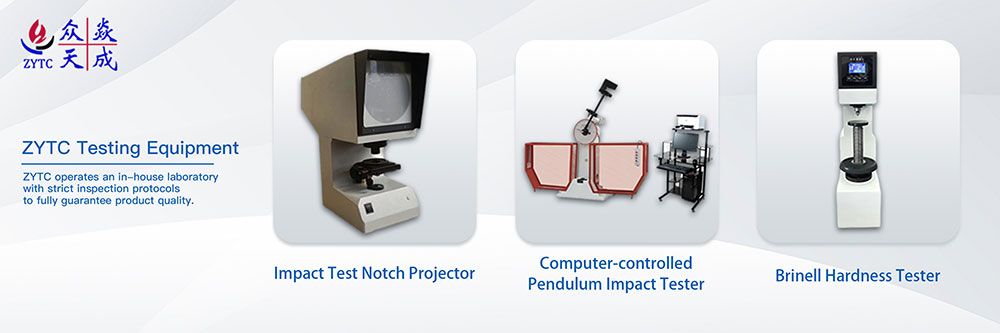
At ZYTC Alloy, we verify every batch in our in-house laboratory:
-
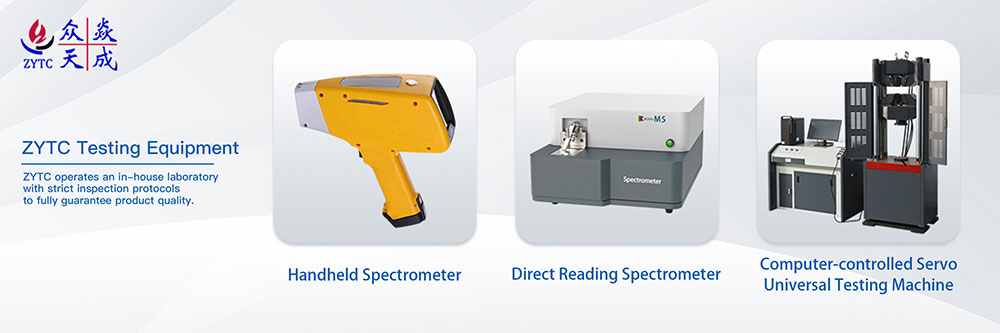
📊 Direct Reading Spectrometry: We strictly verify the chemistry, paying special attention to the Al and Ti content in K500 to ensure it will respond correctly to your heat treatment.
-
💪 Universal Testing Machine: We verify the mechanical properties (tensile and yield strength) to ensure the delivered condition meets ASTM B164 (for 400) or ASTM B865 (for K500) standards.
-
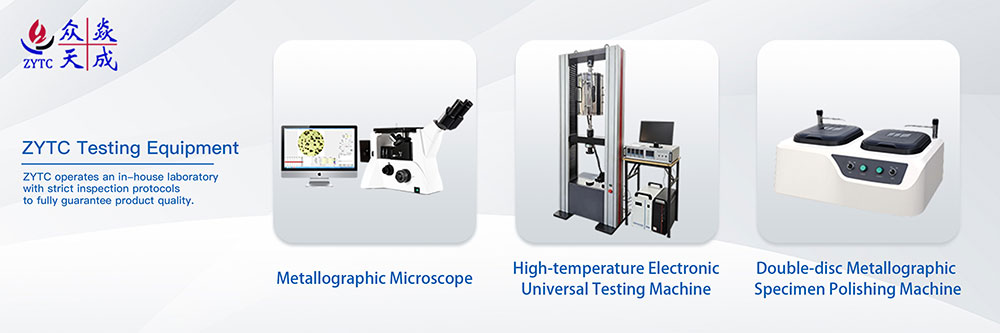
🔬 Metallurgical Microscopy: We inspect the microstructure for uniform grain size and phase distribution.
Need Monel 400 or K500 for Your Next Project?
ZYTC Alloy supplies premium Monel 400 and Monel K500 in bar, rod, wire, tube, sheet, and plate forms, strictly compliant with ASTM, AMS, and DIN standards.
Contact our technical team today for material recommendations, samples, or a quotation with full MTR traceability.
📧 Email: dominic@zytc-steel.com
📱 WhatsApp/WeChat: +86 13132148618