
Precision Alloys Selection Guide: Invar, Kovar, Elgiloy
Structural alloys are chosen for strength. Precision alloys are chosen for a physical behaviour that has to repeat to a few parts per million: how much a part grows when it warms up, how much a spring softens, how easily a core magnetises.
That changes the sourcing problem. A 316L certificate saying "chemistry within specification" is usually enough. The same sentence on a precision alloy certificate is close to useless, because the property you are buying is created by chemistry plus processing plus measurement — and only the third tells you whether the first two worked.
ZYTC Alloy produces controlled-expansion, constant-modulus and soft-magnetic alloys in China and ships them with measured physical data rather than nominal composition alone. What follows is how these five families are actually specified, what goes wrong in procurement, and what to demand before releasing a purchase order.
The five families, and the number that decides the choice
Every family below is specified by one dominant physical property. If a supplier cannot state that number for your heat, the conversation is not about material.
Precision alloy selection matrix
| Alloy (GB / UNS) | Deciding property | Typical value | Typical application | Standard |
|---|---|---|---|---|
| Invar 36 (4J36 / K93600) | CTE | 0.8–1.0 ×10⁻⁶/K, 20–100 ℃ | Optical benches, composite tooling, shadow masks | ASTM F1684 |
| Kovar (4J29 / K94610) | CTE matched to hard glass | ≈4.1–5.0 ×10⁻⁶/K, interval dependent | Glass-to-metal seals, hermetic packages | ASTM F15, F1684 |
| Ni-Span C 902 (3J53 / N09902) | Modulus temperature coefficient | Near zero, −50 to +70 ℃ | Precision springs, tuning forks, hairsprings | Per drawing / AMS |
| Elgiloy (R30003) | Fatigue strength, corrosion | Co-Cr-Ni, not constant-modulus | Guidewires, watch springs, orthodontic wire | Per drawing |
| Hiperco 50 (1J22 / R30005) | Saturation induction Bs | ≈2.4 T (24 kG) | Aircraft generators, magnetic bearings | ASTM A801 |
Family 1 — Controlled expansion: Invar 36 and Kovar
The mechanism is worth knowing, because it explains the failure modes. In Invar 36 (64Ni-36Fe) the magnetostrictive contraction of the alloy offsets normal thermal vibration over a limited temperature range. That compensation is why the expansion is so low, and also why it stops working: above the Curie region the effect fades and the alloy starts expanding like an ordinary steel.
The published figure for Invar 36 is 0.8–1.0 ×10⁻⁶/K between 20 and 100 ℃. That single number hides three things buyers routinely fail to specify: the temperature interval, the measurement direction, and the heat-treatment state. Rolled Invar is anisotropic — a transverse CTE can differ from the longitudinal value — and cold work left in the plate shifts the curve before the part has even been machined.
Kovar (4J29, UNS K94610) is asked for as a low-expansion alloy, but its job is different. Its expansion curve is engineered to match borosilicate glass such as 7050 through the sealing range, so that the seal remains in compression at every temperature the device sees. “Kovar” alone is an incomplete requirement; the glass type is the actual specification. Seal failures traced back to a mismatched glass are common, and the certificate never shows it.
Two process points decide the outcome more than the certificate does. Invar must be stress-relieved after rough machining and before finish machining, otherwise the part moves after the final cut no matter how good the plate was. Kovar needs controlled decarburisation and oxide management before sealing; a bright, clean surface that was never decarburised will not wet the glass consistently.
Family 2 — Constant modulus: Ni-Span C 902, and why Elgiloy is not one of them
Ni-Span C 902 (3J53, UNS N09902) holds an almost constant elastic modulus over roughly −50 to +70 ℃, which is what makes a spring stay calibrated across a temperature swing. It is the alloy behind precision springs, tuning forks, load cells and instrument hairsprings.
Elgiloy (UNS R30003, sold in Europe as Phynox) is usually listed alongside Ni-Span C because both are used for springs, but it is not an Elinvar-type alloy. Its value is fatigue strength and corrosion resistance in a cobalt-chromium-nickel matrix — the reason it ends up in guidewires, watch springs and orthodontic wire. If a design needs temperature-compensated modulus, Elgiloy is the wrong answer; if it needs a spring that survives a million cycles in saline, Ni-Span C 902 is.
Family 3 — Soft magnetic: Hiperco 50
Hiperco 50 (1J22, UNS R30005) is a 49Co-2V iron-cobalt alloy with a saturation induction of about 2.4 T, against roughly 2.1 T for silicon iron and 0.8 T for 80Ni permalloy. In a generator or a magnetic bearing that difference translates directly into smaller, lighter cores — which is why it appears in aircraft generators and active magnetic bearings rather than in cheap transformers.
The property is made in the furnace, not in the melt. Final annealing runs in dry hydrogen at around 850 ℃; atmosphere purity removes carbon, oxygen and sulphur, and those residuals are what set coercivity and permeability. A core annealed in nitrogen will show the right chemistry and the wrong losses. The second half of the problem is sequence: any machining, grinding or even aggressive handling after the final anneal reintroduces stress and degrades the very property that justified the price.
The procurement trap: four ways paper data fails
A composition certificate can be 99 % correct and the part still be unusable, because the property you are paying for lives outside the chemistry. Four failure modes account for most of it.
- A CTE number without an interval or a direction. "1.0 ×10⁻⁶/K" means nothing until it reads "20–100 ℃, longitudinal, annealed". The same alloy quoted over 20–300 ℃ will not meet that number.
- Property measured on the mill’s control sample, not your section. Grain size, CTE and magnetic loss all vary with reduction and position; a report from a different billet is a different material.
- Annealing before machining instead of after. Stress relief and the final hydrogen anneal must be the last thermal step. Cut after anneal and you have paid for properties you then destroyed.
- A certificate with no physical data at all. Chemistry plus hardness is not a specification for a precision alloy, and it will not survive an end-customer audit.
What ZYTC verifies before shipment
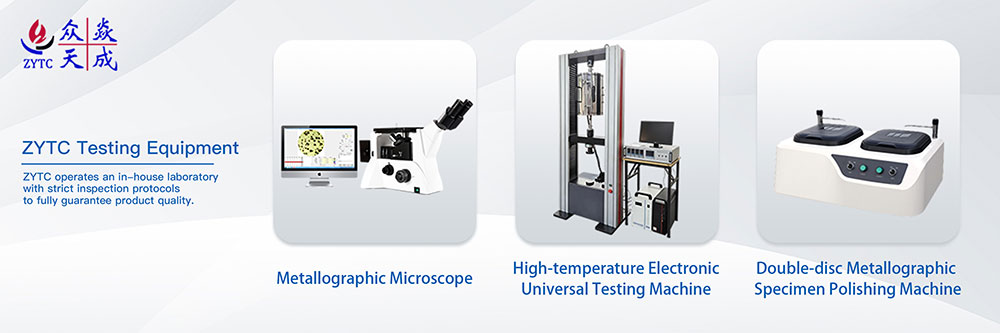
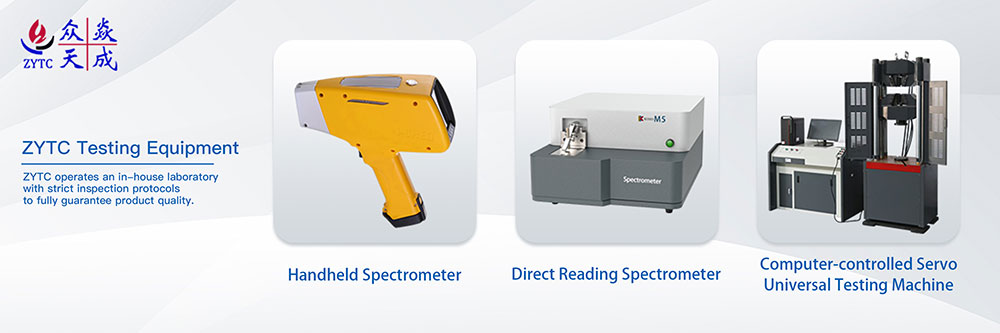
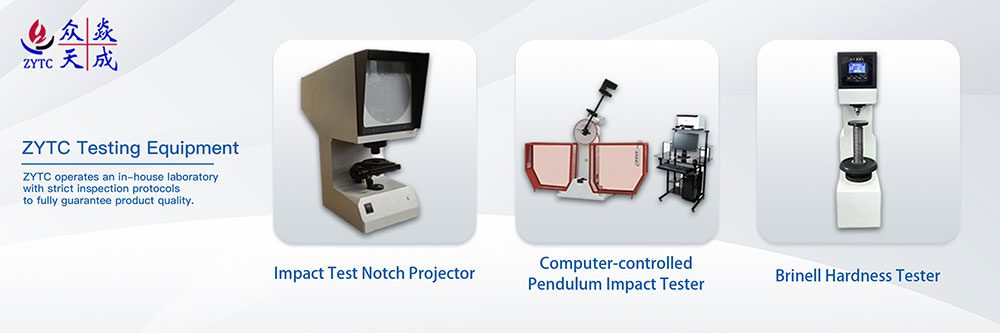
ZYTC Alloy is an integrated manufacturer, not a reseller. Material is melted, processed and measured in the same facility, so the report that arrives with your crate was produced on your material rather than forwarded from someone else's.
Every batch is checked against the property the order was placed for, not against a generic chemistry list:
- Optical emission spectrometry for Ni, Co, Cr, Mo, Ti, V and the residual elements that shift expansion and permeability.
- Dilatometry for the CTE curve over the requested interval, with the test direction and heat-treatment state recorded on the report.
- Magnetic measurement of saturation induction, coercivity and permeability on soft magnetic grades, taken after the final anneal.
- Metallography for grain size, banding and second-phase distribution, which is where processing mistakes surface first.
- Hardness and tensile testing, plus dimensional and surface inspection on finished forms.
Documentation is issued as EN 10204 3.1 with measured values, heat-number traceability from melt to cut length, and third-party inspection by SGS, BV or TÜV where the end user requires it. Trial quantities start at 50 kg, and the same inspection applies to a trial lot as to a production order.
FAQ
- 1. What is the difference between Invar 36 and Kovar?
- Both are iron-nickel based, but they solve different problems. Invar 36 has the lower expansion — roughly 0.8–1.0 ×10⁻⁶/K at room temperature — and is used where dimensional stability matters, such as optical benches and composite tooling. Kovar expands more, but its curve is matched to borosilicate glass so that a glass-to-metal seal stays in compression.
- 2. Is Elgiloy a constant-modulus alloy?
- No. Elgiloy (UNS R30003) is a cobalt-chromium-nickel alloy valued for fatigue life and corrosion resistance. It appears in the same conversation as Ni-Span C 902 because both make springs, not because it has a temperature-compensated modulus.
- 3. Why does Hiperco 50 need hydrogen annealing?
- Carbon, oxygen and sulphur residuals raise coercivity and cut permeability. A dry hydrogen anneal at around 850 ℃ removes them and produces the losses the grade is bought for. Annealing in an inert gas gives the right chemistry with the wrong magnetics.
- 4. Can I machine a precision alloy after the final anneal?
- You can, but you will lose part of the property you paid for. Stress from cutting redistributes and degrades expansion behaviour and magnetic performance. Where the drawing allows: rough machine, stress relieve, finish machine, final anneal.
- 5. What is the smallest order you can quote?
- Trial quantities from 50 kg for R&D and first-article work, in bar, wire, strip or plate. The inspection sequence is the same as for a multi-ton order.
Request a quote with the physical data attached
Send the property that matters, the temperature interval, the form and the delivery state. The quotation will name the grade with its GB and UNS designation, the anneal sequence, and the measurements that travel with the shipment.
Email: dominic@zytc-steel.com
WhatsApp / WeChat: +86 13132148618