
Nickel Alloys for the Automotive Industry
Nickel Alloys in the Automotive Industry
– Engineering Solutions for Extreme Conditions
The modern automotive industry faces unprecedented challenges. Engines are becoming more powerful yet more efficient. Emissions regulations are increasingly stringent. Components must endure higher temperatures, greater pressures, and more corrosive environments than ever before – all while delivering reliable performance over hundreds of thousands of miles.
At ZYTC Alloy, we understand these demands. As a leading Chinese manufacturer and global supplier of high-performance nickel-based alloys, we provide advanced material solutions that enable automotive engineers to push the boundaries of design, durability, and efficiency.
From engine and transmission components to exhaust systems and turbocharger hardware, nickel alloys play an increasingly critical role in the vehicles of today and tomorrow.
Why Nickel Alloys for Automotive Applications?
Nickel alloys offer a unique combination of properties that make them indispensable for high-performance and extreme-condition automotive applications:
| Property | Benefit for Automotive Components |
|---|---|
| High-Temperature Strength | Maintains structural integrity in turbochargers, exhaust manifolds, and combustion chambers |
| Excellent Corrosion Resistance | Resists oxidation, sulfidation, and salt-induced corrosion in underbody and exhaust systems |
| Outstanding Wear Resistance | Ideal for gears, bearings, and sliding components subject to friction and fatigue |
| Good Malleability and Formability | Enables complex component geometries through forging, machining, and welding |
| Creep and Fatigue Resistance | Extends component life under cyclic thermal and mechanical loading |
| Thermal Expansion Compatibility | Matches with other materials in multi-metal assemblies |
Key Automotive Applications for Nickel Alloys
🔧 Engine Components
The engine compartment is one of the most demanding environments in any vehicle. High temperatures, corrosive combustion gases, and mechanical vibration create conditions that ordinary materials cannot withstand.
Common Nickel Alloy Applications:
-
Valves and Valve Seats: Nickel alloys such as Nimonic® 80A and Inconel® 751 are used for exhaust valves that must resist high-temperature oxidation, creep, and wear.
-
Turbocharger Components: Turbine wheels and housings are exposed to exhaust gases exceeding 1600°F (870°C). Alloys like Inconel® 713C and Hastelloy® X provide the necessary high-temperature strength and oxidation resistance.
-
Piston Rings and Pins: Nickel alloy materials offer excellent wear resistance and high-temperature stability, ensuring long service life in high-performance engines.
-
Glow Plugs and Ignition Systems: Nickel-chromium alloys provide reliable heat generation and oxidation resistance for diesel and high-compression engines.
🔧 Transmission and Drivetrain
Transmission components are subject to high contact stresses, sliding friction, and cyclic loading. Nickel alloys contribute to durability and reliability in these critical systems.
Common Nickel Alloy Applications:
-
Gears and Bearings: Wear-resistant nickel alloys extend component life under high-load conditions.
-
Clutch Components: High-strength nickel alloys maintain friction characteristics and structural integrity under repeated engagement cycles.
-
Synchro Rings and Shafts: Nickel-based materials offer excellent fatigue strength and resistance to galling.
🔧 Exhaust and Emissions Systems
Modern exhaust systems operate at elevated temperatures and handle aggressive combustion byproducts – including water vapor, sulfur compounds, and chlorides – that can cause rapid corrosion of standard steels.
Common Nickel Alloy Applications:
-
Exhaust Manifolds: Inconel® 625 and Alloy 800 provide superior oxidation resistance at temperatures up to 1800°F.
-
Catalytic Converter Substrates: Nickel alloy foils and honeycomb structures support catalyst materials while resisting thermal shock and chemical attack.
-
EGR (Exhaust Gas Recirculation) Coolers: Nickel alloy tubing withstands acidic condensate corrosion and high-temperature exhaust gases.
-
Exhaust Gas Sensors: Sensor housings and sheaths require accurate temperature sensing and resistance to corrosive environments, often using Inconel® 600 or similar alloys.
🔧 Fuel Systems and Injection Components
With the rise of high-pressure direct injection and alternative fuels, fuel system components must resist corrosion from aggressive fuel additives and high-pressure cycles.
Common Nickel Alloy Applications:
-
Fuel Injector Nozzles: Nickel alloys resist wear, erosion, and corrosion from high-pressure fuel flows.
-
Fuel Pump Components: Wear-resistant nickel alloys ensure long service life under continuous operation.
-
Fuel Lines and Fittings: Corrosion-resistant tubing maintains integrity when exposed to biofuels, ethanol blends, and other fuel formulations.
🔧 Electrical and Sensor Systems
Nickel alloys are also used extensively in automotive electrical systems, leveraging their controlled thermal expansion, conductivity, and corrosion resistance.
Common Nickel Alloy Applications:
-
Thermostat Valves: Nickel-iron alloys provide precise thermal response for engine cooling systems.
-
Sensor Sheaths and Housings: Inconel® 600 and similar alloys protect temperature, pressure, and oxygen sensors from harsh underhood environments.
-
Battery Connections and Terminals: Nickel alloys offer reliable conductivity and corrosion resistance in hybrid and electric vehicle battery systems.
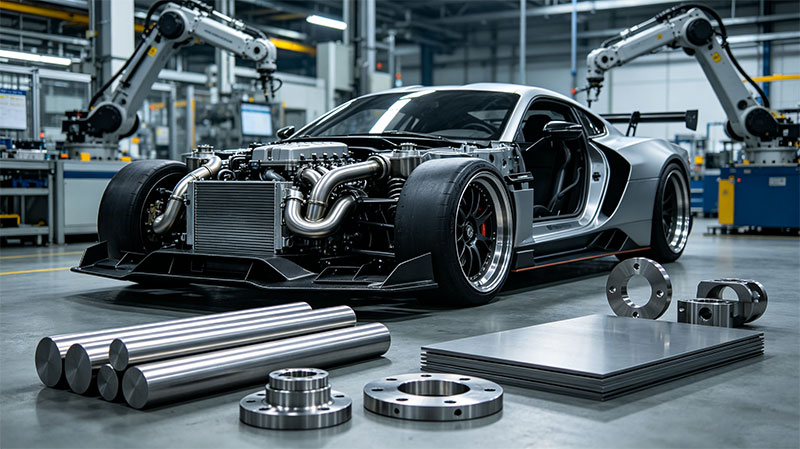
ZYTC Alloy – Your Automotive Nickel Alloy Partner
Why Leading Automotive OEMs and Tier 1 Suppliers Choose ZYTC Alloy
| Capability | What We Deliver |
|---|---|
| Comprehensive Alloy Portfolio | Inconel®, Hastelloy®, Monel®, Nimonic®, Waspaloy®, MP159, Alloy 800/825, and custom grades |
| Multiple Product Forms | Bar, plate, sheet, strip, wire, pipe, tube, forgings, and custom-machined components |
| International Standards | ASTM, AMS, EN, JIS, GB – fully certified and traceable |
| Precision Manufacturing | CNC machining, forging, rolling, heat treatment, and surface finishing |
| Stringent Quality Control | Chemical analysis, mechanical testing, dimensional inspection, NDT (UT, ET, PT) |
| Expert Technical Support | Metallurgical consultation for material selection and application engineering |
| Global Supply Chain | Reliable delivery to North America, Europe, Asia, and the Middle East |
Custom Manufacturing for Automotive Applications
ZYTC Alloy supports automotive manufacturers with prototype development and production parts. Our flexible manufacturing lines handle both small-batch, high-complexity components and high-volume, cost-effective production.
-
Prototype Parts: Rapid turn-around for design validation and testing
-
Production Parts: Scalable manufacturing for volume requirements
-
Made-to-Print: Precision components manufactured to your exact specifications
-
Near-Net Shapes: Forgings and rough-machined parts to minimize material waste and machining time
Key Nickel Alloy Grades for Automotive Applications
| Alloy | UNS / W.Nr. | Primary Automotive Applications | Key Properties |
|---|---|---|---|
| Inconel® 718 | N07718 / 2.4668 | Turbocharger wheels, high-temp fasteners | High strength to 1300°F, excellent fatigue resistance |
| Inconel® 625 | N06625 / 2.4856 | Exhaust manifolds, EGR coolers, sensor sheaths | Outstanding corrosion and oxidation resistance |
| Inconel® 600 | N06600 / 2.4816 | Glow plugs, thermocouple sheaths, sensor housings | Oxidation resistance to 2000°F, good formability |
| Inconel® 751 | N07751 | Exhaust valves, turbine seals | Precipitation-hardenable, high creep resistance |
| Nimonic® 80A | N07080 / 2.4952 | Exhaust valves, high-temp springs | Creep and fatigue resistance at elevated temperatures |
| Hastelloy® X | N06002 / 2.4665 | Combustion chambers, turbocharger housings | Excellent oxidation resistance at high temperatures |
| Waspaloy® | N07001 / 2.4654 | Turbocharger discs, high-temp fasteners | Age-hardenable, high strength to 1600°F |
| MP159 | R30159 | High-strength fasteners, landing gear (also used in high-performance automotive) | Ultra-high strength, corrosion resistant |
| Alloy 800 / 825 | N08800 / N08825 | EGR systems, exhaust components, fuel lines | Stress-corrosion cracking resistance, good fabricability |
® Registered trademarks of their respective owners.
Why Nickel Alloys Are Gaining Importance in the Automotive Industry
1. Downspeeding and Turbocharging
Modern engines are smaller, turbocharged, and operate at higher specific outputs. This translates to higher cylinder pressures and exhaust temperatures. Nickel alloys provide the high-temperature strength and thermal fatigue resistance required for these demanding conditions.
2. Lightweighting and High-Strength Requirements
While nickel alloys are denser than aluminum or titanium, their superior strength at temperature allows for thinner, more compact component designs – sometimes resulting in weight savings when compared to lower-strength materials that require heavier sections.
3. Emissions Reduction and Corrosion Resistance
EGR systems, while reducing NOx emissions, introduce acidic condensates into engine and exhaust systems. Nickel alloys resist these corrosive environments, ensuring long component life without excessive maintenance.
4. Electrification and Hybridization
Electric and hybrid vehicles present new challenges – including cooling of power electronics, high-voltage battery contacts, and thermal management of electric motors. Nickel alloys are well-suited to these applications due to their thermal stability, corrosion resistance, and controlled expansion characteristics.
Professional Quality Assurance at ZYTC Alloy
At ZYTC Alloy, we strictly enforce standardized, process-driven, and professionally managed production and inspection workflows. Our quality assurance program includes:
-
Raw Material Verification – Spectrometric analysis to confirm chemical composition
-
Dimensional Inspection – Precision measurement of all critical dimensions and tolerances
-
Mechanical Testing – Tensile, hardness, and impact testing per ASTM/AMS standards
-
Non-Destructive Testing (NDT) – Ultrasonic, eddy current, and dye penetrant inspection
-
Surface Quality Control – Visual inspection and finish verification
-
Heat Treatment Monitoring – Precise process control for solution treatment, aging, and annealing
-
Traceability – Complete documentation from melt to shipment
-
Third-Party Support – Full cooperation with SGS, BV, TUV, and client-inspectors
Frequently Asked Questions
Q: Why are nickel alloys preferred over stainless steels in automotive applications?
A: While stainless steels offer good corrosion resistance, nickel alloys provide superior high-temperature strength, better creep resistance, and more robust oxidation protection – particularly above 1200°F (650°C). Nickel alloys also maintain ductility and toughness at both high and cryogenic temperatures.
Q: Are nickel alloys suitable for high-volume automotive production?
A: Yes. ZYTC Alloy has the manufacturing capacity and expertise to supply nickel alloys for both prototype development and high-volume production. Our processes are optimized to meet the cost and lead time requirements of the automotive industry while maintaining rigorous quality standards.
Q: Can ZYTC Alloy provide custom components for automotive applications?
A: Absolutely. We offer a full range of custom manufacturing services, including forging, precision machining, heat treatment, and surface finishing. We can produce components from your drawings and specifications.
Q: What standards do ZYTC Alloy automotive products comply with?
A: We manufacture in compliance with international standards including ASTM, AMS, AISI, JIS, and GB. We also support client-specific specifications and third-party approvals.
Q: How does ZYTC Alloy ensure quality and consistency?
A: Our integrated production and inspection processes, combined with ISO 9001 and AS9120 quality management systems, ensure consistent quality across every batch. We also maintain complete traceability from raw material to finished product.
Q: What is the lead time for nickel alloy automotive components?
A: Lead times depend on alloy type, form, and quantity. Please contact our team with your specific requirements for a detailed quotation and delivery schedule.
Contact ZYTC Alloy for Your Automotive Nickel Alloy Needs
Whether you are developing next-generation engines, optimizing emissions systems, or manufacturing high-performance drivetrain components, ZYTC Alloy has the material expertise, manufacturing capabilities, and quality commitment to support your success.
📧 Email: dominic@zytc-steel.com
📲 WhatsApp/WeChat: +86 13132148618
Partner with ZYTC Alloy for reliable, high-performance nickel alloy solutions – engineered for the road ahead.